

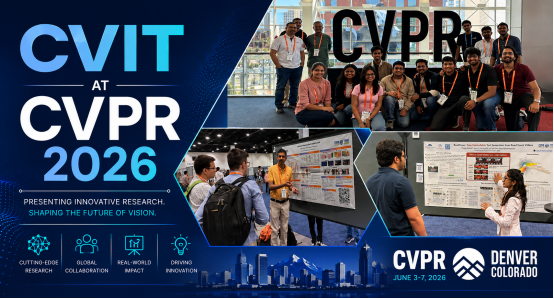
Demonstrating the depth and diversity of its research, CVIT secured both a Best Paper Award at the CVPR Workshop on Computer Vision with Small Data and a Best Paper Runner-up Award at the Workshop on 3D Geometry Generation for Scientific Computing, while presenting ten papers across the CVPR Main Conference, CVPR Findings, and CVPR Workshops. The centre's presence at the conference spanned video understanding, 3D vision, generative AI, multimodal AI, document intelligence, vision-language learning, and scientific communication.
CVPR 2026 attracted more than 16,000 paper submissions, with only about 25% accepted, making these honours a significant milestone for the institute and its researchers
Best Paper Award: Improving Video Understanding with Structured Descriptions
At the CVPR Workshop on Computer Vision with Small Data: Beyond Scale Toward Data-Efficient Dynamically-Aware Video Intelligence (CV4Smalls), Darshan Singh, a Master's graduate and Predoctoral Researcher at Google DeepMind, presented "SRL-CLIP: Efficient CLIP Video Adaptation via Structured Semantic Role Labels," which won the Best Paper Award. The work, co-authored with Zeeshan Khan and advised by Prof. Makarand Tapaswi, explores how to make AI models such as CLIP understand videos more effectively using semantic role labels instead of relying solely on massive caption datasets.
Traditional video-language models often miss important contextual information. The research introduces structured semantic descriptions that capture who is doing what, to whom, when, and where, providing richer supervision for training AI models.
"CLIP is already good at connecting images and text. But video captions often leave out important details. By using semantic role labels, we were able to train a strong video-understanding model using only a small amount of data," said Darshan Singh.
The work demonstrates that carefully structured language supervision can significantly improve video understanding while dramatically reducing the amount of training data required, highlighting the potential of data-efficient AI.
Best Paper Runner-up: Making 3D AI Models Faster and More Efficient
Dual-degree graduate Kunal Bhosikar received the Best Paper Runner-up Award for his research presented at the Workshop on 3D Geometry Generation for Scientific Computing. His work introduces a technique that significantly simplifies AI-generated 3D models without compromising their visual quality.
Modern generative AI systems can create highly detailed 3D assets from images, videos, or text prompts. However, these models often contain thousands of tiny triangles, making them computationally expensive to store, render, and manipulate. Kunal's approach intelligently removes unnecessary geometric complexity while preserving the model's overall shape and texture, making these models significantly faster and more efficient to use.
"Today's AI systems can generate incredibly detailed 3D models from images, videos and even text prompts. But these models contain thousands of tiny triangles, making them expensive to store and process. Our technique removes unnecessary triangles while preserving the shape and texture, making them much faster to use," explained Kunal.
Protecting Images from AI Reconstruction
In addition to his award-winning work, Kunal also presented a second paper focused on protecting photographs from unauthorized AI-based 3D reconstruction. The team developed an almost invisible digital patch that disrupts AI reconstruction pipelines while remaining imperceptible to human viewers.
"We developed an almost invisible digital patch that disrupts AI reconstruction pipelines while remaining unnoticed by humans," he said.
Kunal's other paper, titled "PatchPoison: Poisoning Multi-View Datasets to Degrade 3D Reconstruction," was presented at the SPAR-3D Workshop (poster presentation and lightning talk). The work, carried out under the guidance of Profs. Ankit Gangwal and Charu Sharma, addresses a growing concern in the AI era: protecting images from being used to create unauthorized 3D models.
Research Highlights from CVPR 2026
Beyond the two award-winning papers, CVIT researchers presented work across the CVPR Main Conference, CVPR Findings, and CVPR Workshops, reflecting the centre's broad research strengths in computer vision and artificial intelligence.
Advancing Video Understanding. At the newly introduced CVPR Findings Track, undergraduate researcher Balaji Darur, pursuing a B.Tech. in Computer Science and an M.S. by Research in Computational Linguistics, presented "One Identity, Many Roles: Multimodal Entity Coreference for Enhanced Video Situation Recognition," co-authored with Amanmeet Garg and Prof. Makarand Tapaswi. The research addresses a key challenge in video AI systems: consistently tracking people and objects across changing appearances, viewpoints, and roles. "We have introduced a new approach known as Multimodal Entity Coreference that helps AI connect people and objects mentioned in text with what appears on screen throughout an entire video," said Balaji.
Making AI Better at Understanding Images. Researcher Vaibhav Agrawal, together with collaborators, presented "SeeThrough3D: Occlusion Aware 3D Control in Text-to-Image Generation" at CVPR 2026. The framework improves how AI image generation models understand occlusion, enabling more accurate placement and interaction of multiple objects in generated scenes.
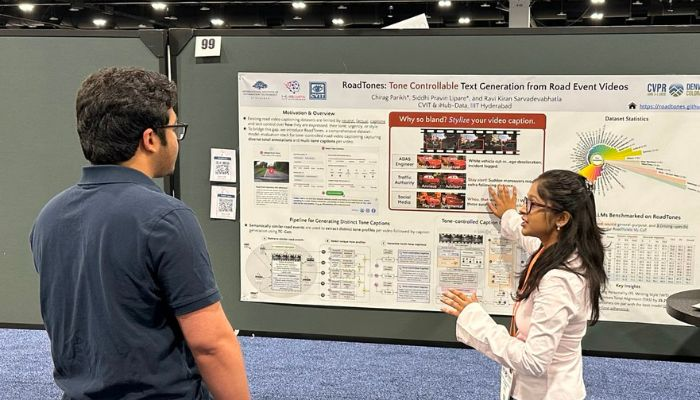
Audience-Aware AI for Road Safety. Chirag Parikh, Siddhi Pravin Lipare, and Prof. Ravi Kiran Sarvadevabhatla presented "RoadTones: Tone Controllable Text Generation from Road Event Videos" in CVPR Findings, introducing a novel AI system that goes beyond identifying events in road videos to generating descriptions tailored to different audiences and contexts. This audience-aware approach has the potential to make AI-powered traffic monitoring, autonomous driving, and road safety communication more effective and accessible.
Strengthening Vision-Language AI. Prof. Vineet Gandhi's research group, led by Aishwarya Agarwal and co-authored by Srikrishna Karanam, had two papers accepted at CVPR 2026: "Concept Regions Matter: Benchmarking CLIP with a New Cluster-Importance Approach," introducing a new framework for improving the interpretability of CLIP models, and "LiteEmbed: Adapting CLIP to Rare Classes," accepted to CVPR Findings, presenting a lightweight approach for adapting CLIP models to recognise rare classes using only a few examples without retraining the encoders.
Advances in Document Intelligence and Scientific Communication
CVIT researchers also made significant contributions to document intelligence and scientific communication.
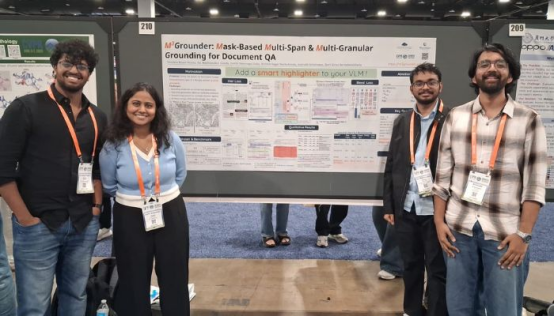
"M3Grounder: Mask-Based Multi-Span and Multi-Granular Grounding for Document QA," a team effort by Prof. Ravi Kiran and Venkata Kesav Venna, Sai Madhusudan Gunda, Jyothi Swaroopa Jinka, Hrithik Sagar, and Anirudh Srinivasan from IIIT-H and the BharatGen group, advances AI's ability to understand complex document layouts for document question answering. "The future of document AI isn't just answering questions. Because in real-world domains — finance, healthcare, legal, enterprise workflows — answers alone aren't enough. Trust comes from verifiable evidence," says Prof. Ravi Kiran.
Meanwhile, Megha Mariam K. M., Vineeth N. Balasubramania, and Prof. C. V. Jawahar presented "Unifying Scientific Communication: Fine-Grained Correspondence Across Scientific Media" at CVPR Findings 2026, introducing methods that help AI connect information across scientific papers, figures, tables, and other research media. "Scientific research is often communicated through multiple formats, including research papers, presentation slides, conference talks, and explainer videos. Although they all describe the same work, these formats are rarely connected in a way that allows readers to seamlessly navigate between them or understand how a concept is presented across different media," explains Megha Mariam K. M.
To address this challenge, the researchers developed the Multimodal Conference Dataset (MCD), the first dataset that brings together scientific content from multiple communication formats for the same research. Using MCD to evaluate leading AI models, the team found that while current systems perform reasonably well at linking text and images, they continue to struggle with aligning fine-grained scientific concepts — particularly mathematical equations — across different media.
Additional Research Contributions
CVIT researchers also presented:
- "Face Time Traveller: Travel Through Ages Without Losing Identity," by Purbayan Kar, Ayush Ghadiya, Vishal Chudasama, Pankaj Wasnik, and C. V. Jawahar, accepted to CVPR 2026.
- "EW-DETR: Evolving World Object Detection via Incremental Low-Rank Detection TRansformer," by Munish Monga, Vishal Chudasama, Pankaj Wasnik, and C. V. Jawahar, accepted to CVPR 2026.
Leadership at CVPR 2026
Further strengthening IIIT Hyderabad's presence at the conference, Prof. C. V. Jawahar delivered a keynote address at one of the CVPR workshops, showcasing the institute's leadership within the global computer vision community. Adding to the celebrations, an earlier CVIT research paper also received the EgoVis Distinguished Paper Award, highlighting the institute's continued excellence in egocentric vision research. The paper presented Ego-Exo4D, a large public dataset designed to help computers better understand how people perform real-world skills. It contains more than 1,200 hours of video of people engaged in activities such as sports, music, dance, and bike repair.
A Landmark Achievement for CVIT
Winning both the Best Paper Award and the Best Paper Runner-up Award at CVPR Workshops 2026, alongside ten accepted papers across the CVPR Main Conference, CVPR Findings, and CVPR Workshops, marks a landmark achievement for CVIT. These accomplishments reflect the centre's commitment to advancing the frontiers of artificial intelligence and computer vision through impactful, globally recognised research.
From making video understanding more data-efficient and simplifying AI-generated 3D models to improving multimodal AI, image generation, document intelligence, scientific communication, and vision-language learning, CVIT researchers continue to shape the future of AI research on the global stage.