| Introduction :: |
Visibility culling of a scene is central to any interactive graphics application. The idea is to limit the geometry sent down the rendering pipeline to only the geometry with a fair chance of finally becoming visible. It is important for the culling stage to be fast for it to be effective; otherwise the performance gain achieved will be overshadowed. Hierarchical scene structures are commonly used to speed up the process. Hierarchical culling of bounding boxes to a view frustum is fast and sufficient in most applications. However, when there are multiple view frustums (as in a tiled display wall), visibility culling time becomes substantial and cannot be hidden by pipelining it with other stages of rendering.
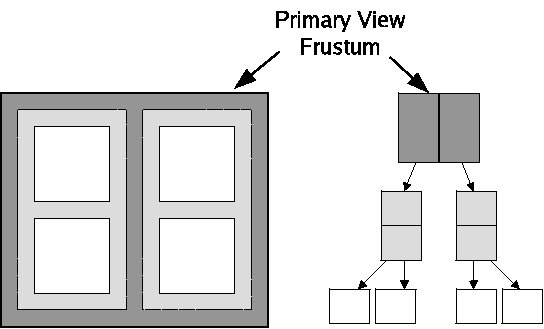
Here, we address the problem of culling an object hierarchy to a hierarchically organized set of frustums, such as those found in tiled displays and shadow volume computation. We present an adaptive algorithm to unfold the Object Hierarchy (OH) or Frustum hierarchy (FH) at every stage in the culling procedure. Our algorithm computes from-point visibility and is conservative. The precomputation required is minimal, allowing our approach to be applied for dynamic scenes as well.
| Design & Features :: |
Features of the Adaptive OH and FH culling Algo ::
|
|
|
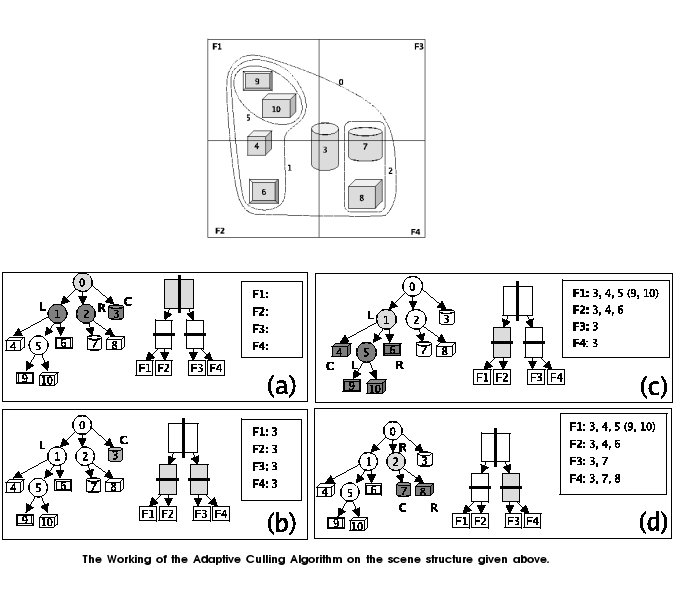
We first find all the objects in the Primary view frustum and then call the
Adaptive algorithm for every object present inside the Primary view frustum. The
Adaptive algoritm is recursive in nature. The basic steps involved are::
Algorithm Adaptive Culling. Inputs: Object Node and Frustum Node
The time complexity of the algorithm is roughly of O (min (N*logM, M*logN)) where N = Number of objects and M = Number of view frustums. |
| Related Publication :: |
Nirnimesh, Pawan Harish, P.J. Narayanan: Culling an Object Hierarchy to a Frustum Hierarchy. In: Indian Conference on Computer Vision, Graphics and Image Processing (2006)
Nirnimesh, Pawan Harish, P.J. Narayanan: Garuda: A Scalable, Geometry Managed Display Wall using Coomodity PC's. Submitted to : IEEE Transactions on Visualization and Computer Graphics (2007)
| Associated People :: |
|
Pawan Harish Nirnimesh |
Prof. P. J. Narayanan |
Last Modified: Thu Feb 1, 16:06:04 IST 2007